
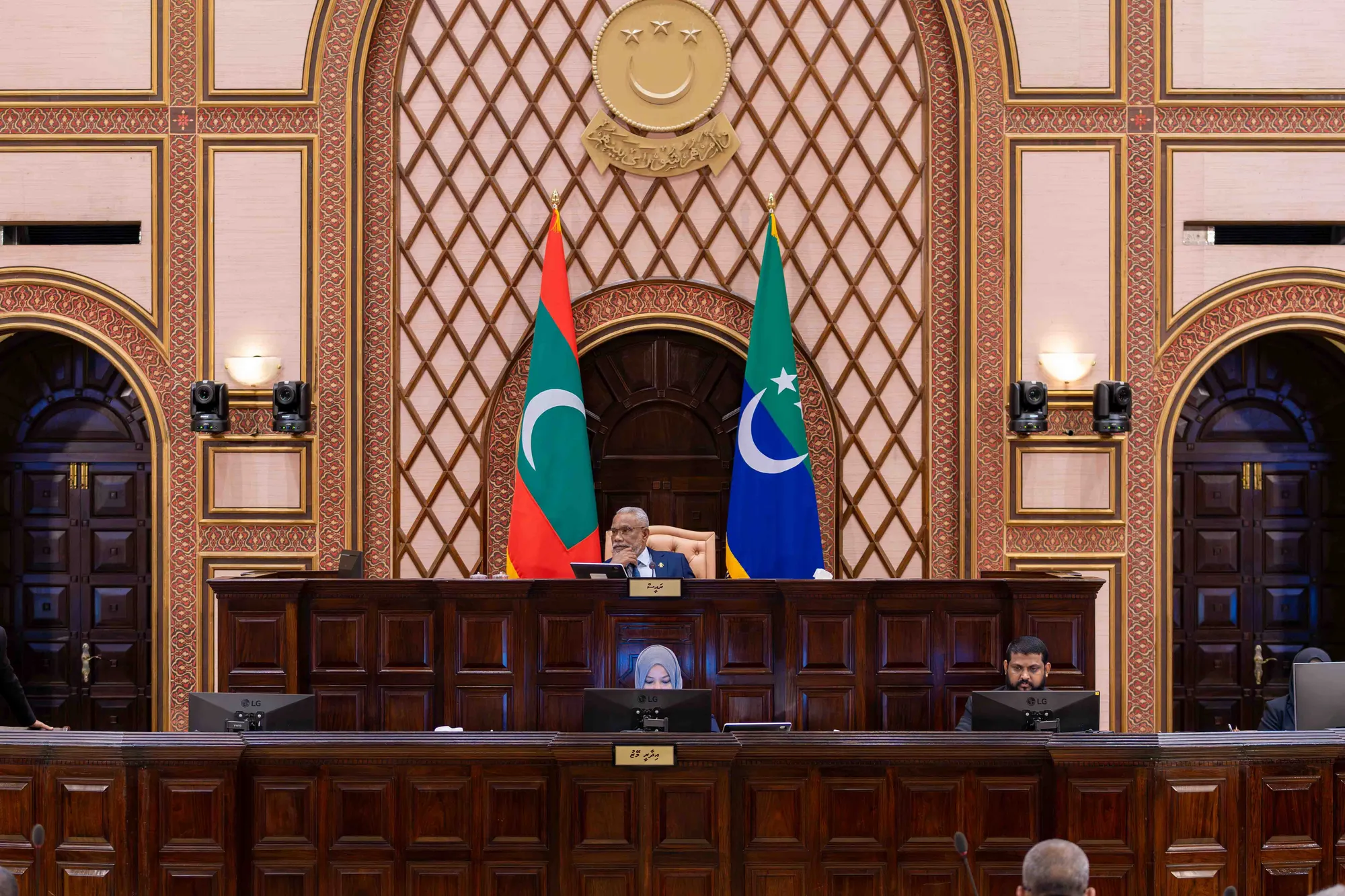
The People's Majlis has accepted a bill establishing the procedures and conditions for imposing and enforcing the death penalty in the Maldives, with all 56 members present voting in favour.
The bill was accepted for consideration during today's parliamentary sitting, with no votes cast against it.
The proposed legislation defines the death penalty as a court-ordered execution of an individual convicted of an offence in a criminal trial before a competent Maldivian court, where capital punishment is prescribed by law.
It sets out five conditions that must be fulfilled before a death sentence can be imposed.
These include ensuring that the offence is punishable by death under existing law, that the case has completed all three levels of the judicial system, and that the trial has been conducted fairly and transparently.
The legislation also requires the accused to have been provided with legal representation.
In cases involving intentional homicide, the victim's heirs must seek Qisas, or retribution, for a death sentence to be carried out.
Under the bill, procedures for implementing a death sentence may begin six months after the Supreme Court delivers its final verdict.
A seven-member panel will oversee the implementation process, with the Maldives Correctional Service responsible for establishing the panel and providing its secretariat.
The proposed legislation also identifies circumstances in which an execution must be postponed.
These include cases where the convicted person is pregnant, in which case the execution would be deferred until the child reaches two years of age, or where a female convict is breastfeeding a child under the age of two.
An execution may also be suspended while a judicial review of the death sentence is pending.
The bill would also allow enforcement to be postponed if the convicted person’s physical health deteriorates significantly or if they have a severe mental health condition, until their condition improves.
On physical illness, the proposed provision differs from one classical Islamic jurisprudential view, which does not treat physical illness alone as grounds for postponing a capital sentence.
The bill stipulates that executions must be carried out by hanging, with the Maldives Correctional Service tasked with overseeing the logistical arrangements and implementation.
It further requires executions to take place in locations hidden from public view.
The recording or broadcasting of any images or sounds associated with an execution, in any form, is prohibited under the proposed legislation.
Leave a comment
Comments
No comments yet. Be the first to comment!